
WIPO Global Innovation Index 2026: Switzerland, Sweden, US, Republic of Korea and Singapore Top Ranking; AI Reshapes Innovation Investments
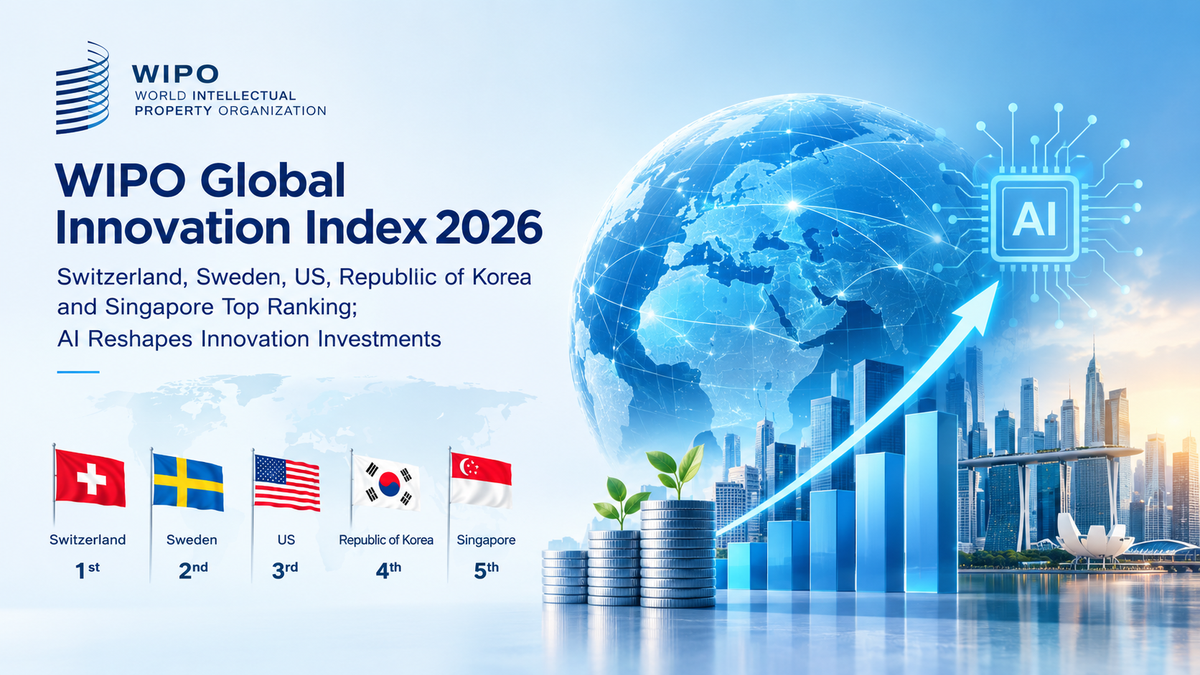
Geneva: Switzerland has retained the top position in the World Intellectual Property Organization's (WIPO) Global Innovation Index (GII) 2026, followed by Sweden, the United States, the Republic of Korea and Singapore.
The 2026 index ranks 139 economies on parameters including research and development, venture capital, high-tech manufacturing, scientific output and intellectual property activity. The report also highlights the growing influence of artificial intelligence (AI) and deep science on global innovation and investment.
Switzerland Leads Global Innovation Ranking
Switzerland has retained the number one position for the 16th consecutive year. Sweden remains second, while the United States ranks third. The Republic of Korea and Singapore complete the top five.
The United Kingdom ranks sixth, followed by the Netherlands, Finland, Denmark and China.
WIPO also noted continued progress among emerging economies, with countries including India, Viet Nam, Türkiye, the Philippines, Morocco and Indonesia strengthening their innovation capabilities.
Global R&D Spending Reaches $3.4 Trillion
Global research and development expenditure increased by more than 3.3% in real terms in 2025 and is expected to grow further in 2026, reaching approximately $3.4 trillion.
Corporate R&D spending also increased significantly, with software and AI companies contributing substantially to the growth. Defence-related research has also emerged as an important driver of R&D investment.
AI Drives Venture Capital Investment
Venture capital funding for innovative startups increased by 28% to $510 billion in 2025, according to the report.
AI accounted for 53% of global venture capital deal value in 2025, with its share rising to 77% in the first half of 2026.
The concentration of investment in AI comes even as the overall number of venture capital deals has declined for the fourth consecutive year.
Deep Science Startups Reach $7.6 Trillion
WIPO's special focus on deep science entrepreneurship found that more than 30,000 deep science startups have been established since 2000.
The combined enterprise value of these companies has reached approximately $7.6 trillion, marking a 23% increase from 2024. Deep science startups attracted around $122 billion in venture capital funding in 2025.
The sector includes companies working in areas such as life sciences, semiconductors, robotics, advanced materials, quantum technologies and space technology.
India Sees Growth in Deep Science
The United States leads the deep science startup ecosystem with 12,752 startups, followed by China with 3,466 and the United Kingdom with 2,133.
India has 453 deep science startups identified in the WIPO tracker.
WIPO also reported that Central and Southern Asia recorded the strongest growth in deep science startups between 2020 and 2025, increasing by 118%, with India being a significant contributor.
IP Plays a Key Role in Deep Science
The report highlights the growing importance of intellectual property in developing and financing deep science companies.
Around 50% of deep science startups hold patents, compared with 15.4% of other startups . WIPO noted that patents can provide important assets for companies with long development cycles by supporting financing, licensing and commercial partnerships.
The GII 2026 findings underline the increasing link between AI, intellectual property, venture capital and scientific research, as countries and companies seek to convert technological breakthroughs into commercially viable innovations.
Source : https://www.wipo.int/pressroom/en/articles/2026/article_0014.html
Comments ()