
India’s Hidden Goldmine: Do Microorganisms Belong to the Regions That Preserve Them?
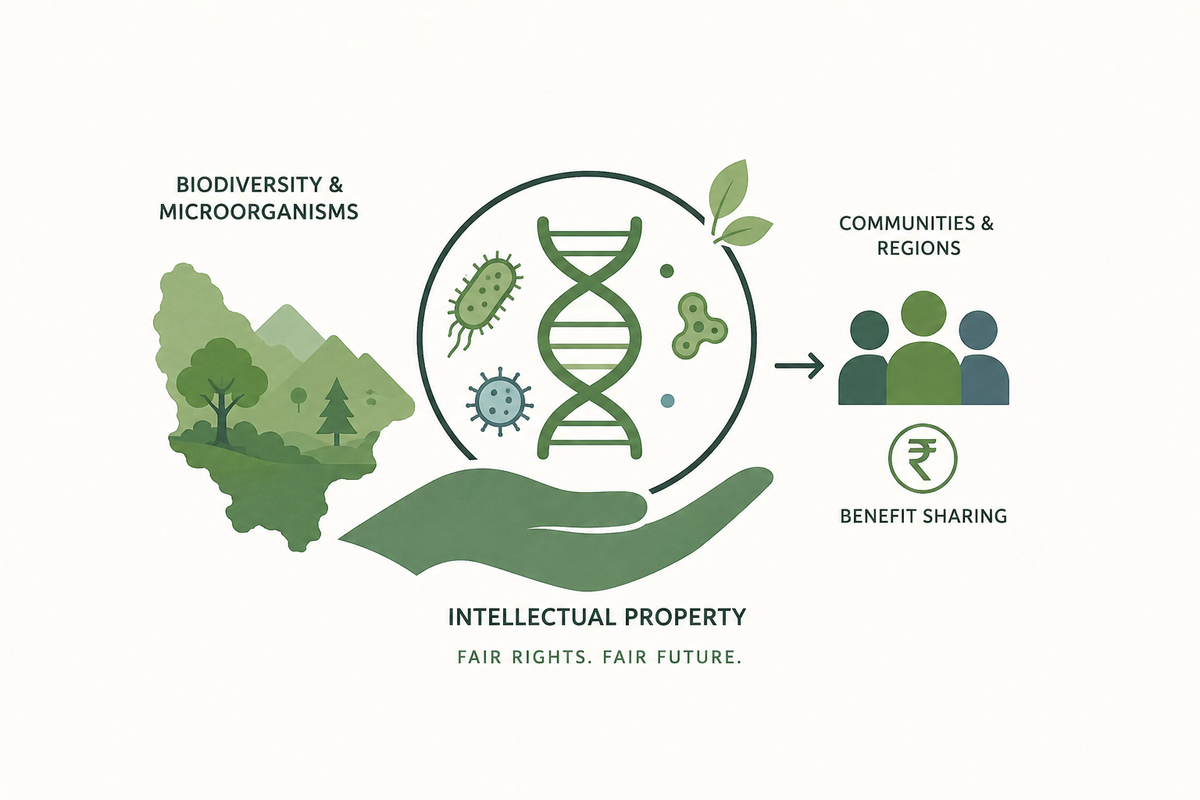
The Emerging IP Battle Over Biodiversity, Traditional Knowledge, and Community Rights
What if the next life-saving antibiotic, climate-resistant agricultural solution, or billion-dollar biotech innovation is hidden inside a microorganism found in a remote Indian forest, desert, or mountain ecosystem?
More importantly — who owns it?
Can a corporation patent discoveries derived from microorganisms collected from indigenous regions without compensating the local communities who protected those ecosystems for generations?
These questions are no longer theoretical. They sit at the heart of one of the most important emerging debates in Intellectual Property law: the ownership and benefit-sharing rights over biological resources and microorganisms.
A recent Press Information Bureau (PIB) release titled “India’s Biodiversity: Commitments and Achievements” highlighted India’s growing biodiversity governance framework, community-led conservation efforts, and implementation of Access and Benefit Sharing (ABS) mechanisms under the Biological Diversity Act.
Reference: https://www.pib.gov.in/PressReleasePage.aspx?PRID=2269147®=48&lang=1
As India strengthens its biodiversity governance under the Biological Diversity Act and the Nagoya Protocol, a new IP perspective is taking shape — one that recognises biodiversity-rich regions and local communities not merely as custodians of nature, but as legitimate stakeholders in scientific and commercial innovation.
The New Age of Intellectual Property: Biology as Wealth
In the 21st century, biological resources have become commercial assets of extraordinary value.
Microorganisms found in specific ecosystems are increasingly used in:
- Pharmaceuticals,
- Genetic engineering,
- Agriculture,
- Industrial biotechnology,
- Cosmetics,
- Environmental restoration technologies.
Scientists today search forests, wetlands, Himalayan ecosystems, coastal zones, and tribal regions for microbial strains capable of producing breakthrough innovations.
But these microorganisms are not randomly distributed. Their uniqueness is often tied directly to:
- regional climate,
- ecological conditions,
- indigenous conservation practices,
- traditional ecological knowledge.
This is where biodiversity intersects with intellectual property law.
Can Nature Be Patented?
Under conventional patent law, naturally occurring organisms in their raw form are generally not patentable. However, isolated microbial strains, modified biological materials, extraction methods, industrial applications, or biotech processes built around them can receive IP protection.
That distinction has enormous consequences.
A microorganism discovered in an Indian ecosystem may eventually become part of:
- patented medicines,
- bioengineering technologies,
- commercial enzymes,
- agricultural innovations worth millions.
The concern is obvious:
If industries profit from biological materials originating from local ecosystems, should local communities receive a share of those benefits?
India’s biodiversity framework answers with a strong and increasingly influential “yes.”
India’s Biodiversity Law Is Quietly Reshaping IP Governance
The Biological Diversity Act, 2002, reinforced by the Biological Diversity (Amendment) Act, 2023, created a legal framework to regulate access to biological resources while ensuring fair and equitable benefit sharing.
The law recognises that biological resources and traditional knowledge are deeply connected with indigenous communities and local ecosystems.
To operationalise this vision, India established:
- the National Biodiversity Authority (NBA),
- State Biodiversity Boards,
- Biodiversity Management Committees (BMCs).
At the grassroots level, People’s Biodiversity Registers (PBRs) document local species, microorganisms, ecological knowledge, and traditional practices.
This is not just environmental documentation.
It is increasingly becoming a form of defensive intellectual property protection.
Microorganisms Are Becoming Regional Assets
Consider this scenario:
A unique fungal strain discovered in a Himalayan village later becomes the basis for a pharmaceutical innovation. Or a desert microorganism contributes to drought-resistant agricultural biotechnology.
Without legal safeguards, corporations could potentially commercialise such discoveries while the originating communities receive nothing.
India’s Access and Benefit Sharing (ABS) mechanism seeks to prevent precisely that.
Under the ABS framework:
- access to biological resources is regulated,
- commercial utilisation requires approvals,
- benefits must be shared with local stakeholders and communities.
This transforms biodiversity from a freely exploitable resource into a protected socio-economic asset.
In effect, regions preserving biological diversity are gradually acquiring a form of economic and legal recognition tied to their natural resources.
Traditional Knowledge: The Invisible Intellectual Property
One of the most revolutionary aspects of India’s biodiversity framework is its recognition of traditional knowledge.
For centuries, indigenous communities have preserved knowledge about:
- medicinal plants,
- microbial fermentation,
- natural healing systems,
- ecological management,
- sustainable agriculture.
Modern industries often build commercial products upon such knowledge systems.
The danger, however, is biopiracy — where corporations or researchers exploit traditional biological knowledge without acknowledgement or compensation.
India’s biodiversity documentation system attempts to close that loophole.
People’s Biodiversity Registers now record:
- local biological resources,
- folk medicinal uses,
- indigenous ecological practices,
- microbial applications,
- community-held knowledge.
This creates evidence of prior community ownership and strengthens resistance against wrongful patent claims.
The Nagoya Protocol and Global Biodiversity Justice
India’s approach aligns with the Nagoya Protocol, a globally significant agreement under the Convention on Biological Diversity that promotes fair and equitable sharing of benefits arising from genetic resources.
The Protocol recognises that:
- nations possess sovereign rights over biological resources,
- local communities cannot be excluded from benefit sharing,
- commercial use of genetic material must follow transparent legal procedures.
This has major implications for multinational biotech and pharmaceutical industries.
The era of unrestricted biological extraction is gradually giving way to a rights-based biodiversity economy.
Biodiversity Is No Longer Just Conservation — It Is Economic Power
India’s biodiversity governance is now evolving into a powerful intersection of:
- environmental law,
- intellectual property,
- indigenous rights,
- biotechnology regulation,
- economic justice.
The scale is already remarkable.
India has established:
- more than 2,76,653 Biodiversity Management Committees,
- over 2,72,648 People’s Biodiversity Registers across the country.
Simultaneously, the ABS mechanism has generated substantial financial benefits for local biodiversity stakeholders.
The message is becoming increasingly clear:
Communities preserving biodiversity are not obstacles to innovation — they are contributors to it.
The Future of IP Will Include Ecology
As biotechnology advances, microorganisms will become some of the world’s most valuable resources.
Future IP disputes may no longer revolve solely around software, trademarks, or patents. They may increasingly concern:
- genetic ownership,
- microbial discoveries,
- biodiversity databases,
- traditional ecological knowledge,
- benefit-sharing rights.
India is positioning itself as a global leader in balancing innovation with biodiversity justice.
The central idea is simple but transformative:
Innovation should reward not only laboratories and corporations, but also the ecosystems and communities that made those discoveries possible.
And in the coming years, that principle may redefine the future of intellectual property law itself.
Comments ()