
Brands Cross the $1 Trillion Mark — But They Still Don't Count as IP Capital
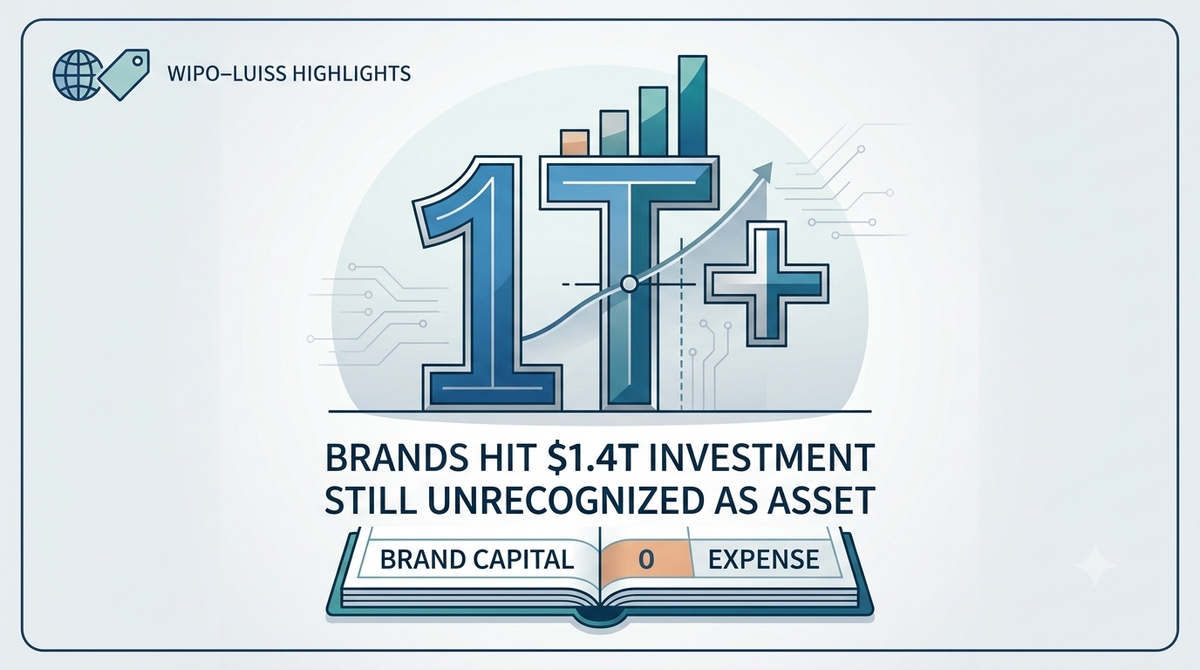
Global brand investment hit an all-time high in 2025. Official statistics still won't call it an asset.
For an asset class that lives entirely in the minds of consumers, brands have become an extraordinarily large line item in the global economy. New data from the WIPO–Luiss Business School World Intangible Investment Highlights 2026 report puts worldwide brand investment at USD 1.4 trillion in 2025, making it, for the first time, a bona fide trillion-dollar category of intangible capital. It has grown at a compound annual rate of 4.2 percent since 2015.
And yet, in the accounting systems that governments and investors rely on, none of it officially exists as an asset.
The world's biggest brand spenders
The United States dominates, with brand investment exceeding USD 566 billion in 2025 — more than four times the amount spent by the second-place United Kingdom (USD 137 billion). Japan (USD 112 billion), Germany (USD 95 billion) and, notably, Brazil (USD 79 billion) round out the top five. Brazil's presence in that group is striking: its brand investment intensity, at 1.9 percent of GDP, outpaces the United States, France, Japan and Germany.
Smaller, trade-exposed economies are leading the growth race rather than the largest ones. Luxembourg posted the fastest brand-investment growth in the sample at 15.6 percent annually over the past decade, followed by Lithuania (11.3 percent) and Denmark (9.1 percent). India isn't far behind at 7.2 percent — a sign that brand-building is becoming a deliberate growth strategy for economies still climbing the value chain, not just a luxury for wealthy ones.
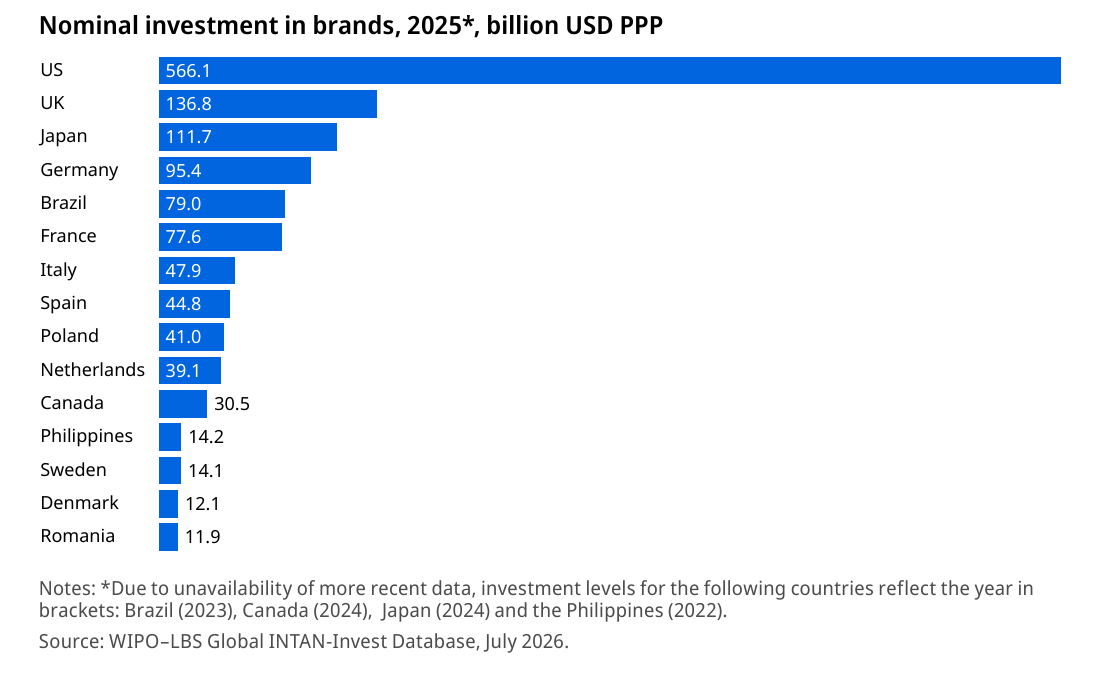
Nominal brand investment, 2025, billion USD PPP. Source: WIPO–LBS Global INTAN-Invest Database, July 2026.
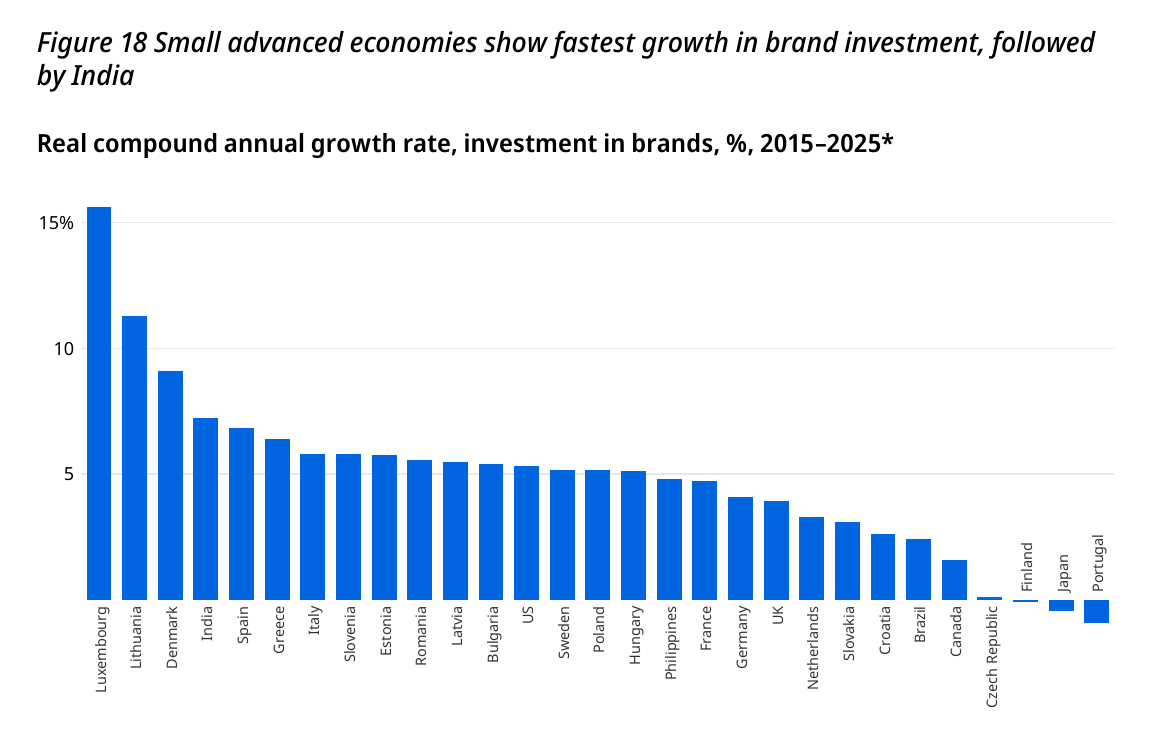
Real compound annual growth rate, brand investment, 2015–2025. Source: WIPO–LBS Global INTAN-Invest Database, July 2026.
Why brands still don't show up on the books
Here's the twist: despite the scale of this spending, brand investment is treated as a current cost — like paying the electricity bill — rather than as capital investment, under the international System of National Accounts (SNA). During the recent 2008-to-2025 SNA revision, an IMF-led task team formally examined whether marketing assets, including brands, should be reclassified and capitalized alongside R&D and software. The UN Statistical Commission declined to adopt the change at its 2024 session, citing both a conceptual objection (the "zero-sum" argument, that brand spending mostly shifts market share between rivals rather than creating new value) and a practical one — the sheer difficulty of separating brand-building investment from routine advertising spend.
The result: brand investment remains folded into the roughly 62 percent of global intangible investment that goes unmeasured in official GDP statistics.
Why this matters for IP strategy
The report frames brands as more than marketing spend — they're productive assets that support pricing power, help firms move up global value chains from contract manufacturing to proprietary, branded products, and act as a trust signal in markets where product quality is hard to verify. That last point is becoming more urgent: as AI-generated content and deepfakes make it harder for consumers to tell what's authentic, a recognized brand functions as a shortcut for trust — arguably raising its economic value at exactly the moment official statistics are refusing to count it.
For trademark owners, brand strategists and IP valuers, the message is clear: the asset class you already knew was valuable is now measurably a trillion-dollar-plus category — the accountants have simply not caught up yet.
Source: WIPO–Luiss Business School, World Intangible Investment Highlights 2026, Global INTAN-Invest Database (July 2026).
Comments ()