
Bicycles, Free Trade, and the 2026 Patent Cliff: How IP Is Reshaping the Indo-European Mobility Corridor
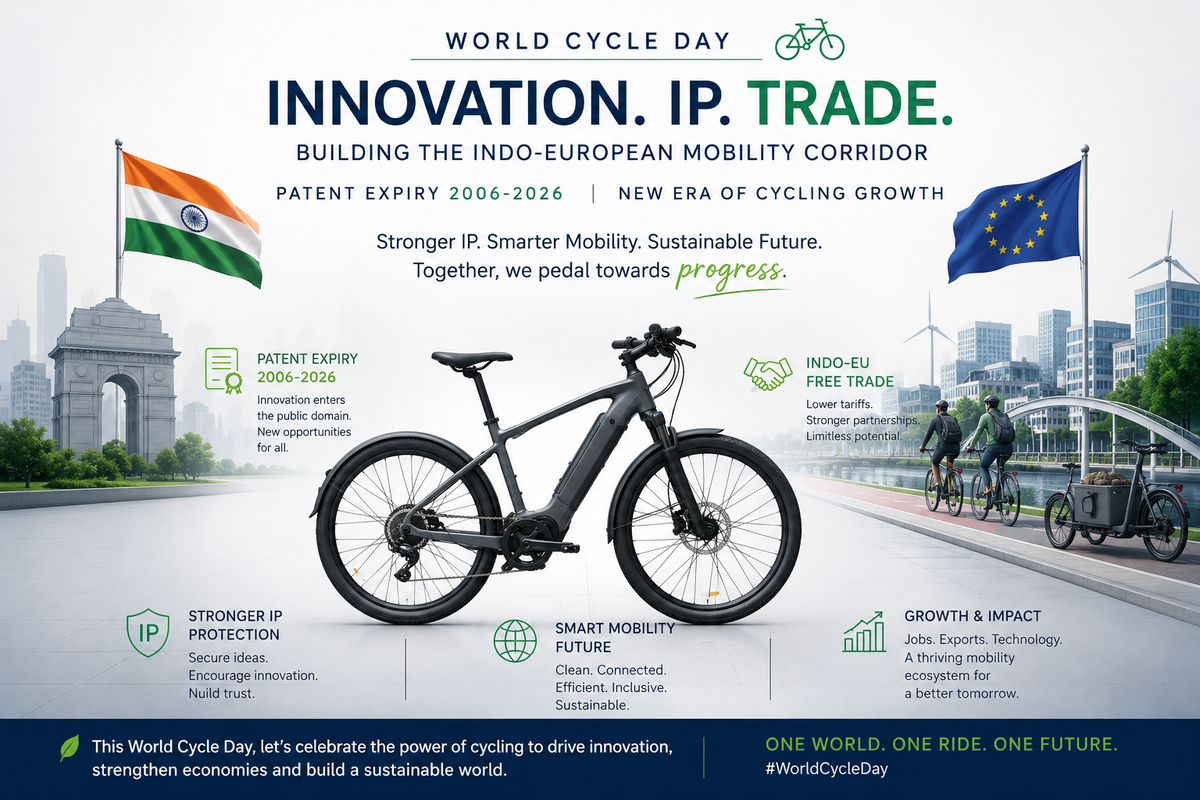
Today, on World Cycling Day, we celebrate more than just a sustainable mode of transport. We celebrate a marvel of continuous industrial refinement. For over a century, the humble bicycle has been a primary battleground for material science, ergonomics, and manufacturing efficiency.
As we look at the global cycling landscape today in 2026, we find ourselves at an extraordinary structural crossroads. The intersection of expiring 20-year patents, evolving trademark strategies, and the newly concluded EU-India Free Trade Agreement (FTA) is radically altering the global micromobility supply chain.
For Indian manufacturers and European brands alike, the rules of the game are changing overnight. Here is how intellectual property (IP) has driven the last century of cycling evolution—and why 2026 marks the dawn of a new competitive era.
1. A Century of Bicycle IP: From Mechanical Refinement to the E-Bike Revolution
A deep dive into data from Google Patents, the USPTO, the European Patent Office (EPO Espacenet), and the Indian Patent Office Journals reveals that bicycle IP history has moved across three distinct macro-waves over the past 100 years:
[1926 - 1970s] ------------> [1980s - 2000s] ------------> [2010s - 2026]
Mechanical Foundations Material Science The Digital & E-Mobility
(Internal Hubs, Braids) (Carbon Fiber, Indexing) S-Curve (Smart Sensors, Hubs)
The Structural Eras of Cycling Patents
- The Mechanical Foundation Era (1920s–1970s): Early filings focused strictly on kinematics—derailleur systems, internal hub gears (Sturmey-Archer), and rim brake mechanics.
- The Material Science & Ergonomics Era (1980s–2000s): The mid-century witnessed an explosion of composite frame designs (carbon fiber layups), dual-suspension geometry for mountain bikes, and integrated brake-shift levers (such as Shimano’s Total Integration patents).
- The E-Mobility & Digital S-Curve (2010s–2026): Over the last decade, traditional mechanical patents have flatlined, entirely replaced by electromechanical filings: torque-sensing bottom brackets, mid-drive motor thermal management, regenerative hub braking, and integrated IoT anti-theft tracking systems.
2. The 2026 Patent Cliff: The Floodgates Open for Smart Micromobility
The legal life of a standard utility patent is exactly 20 years from its filing date under global TRIPS compliance. Because the mid-2000s marked the initial commercial boom of premium e-bikes and advanced frame geometries, 2026 is a massive "Patent Cliff" year for the cycling industry.
A wave of foundational patents originally filed in 2006 by tier-1 Japanese, American, and European component giants are officially expiring this year.
What is entering the public domain in 2026? Foundational utility patents covering integrated mid-drive motor brackets, early-generation electronic wireless shifting protocols, and specific aerodynamic carbon-weave patterns are losing their 20-year exclusivity.
For Indian original equipment manufacturers (OEMs), this is a historic window. Technologies that previously required heavy licensing fees are now public domain text. This allows domestic engineering firms to legally adapt, iterate, and manufacture high-performance, export-grade micro-mobility components at a fraction of the historical cost.
3. The Structural Impact on the India-Europe Trade Corridor
This technological shifts aligns perfectly with geopolitical tailwinds. Following the conclusion of the EU-India Free Trade Agreement (FTA) negotiations, the bilateral trade framework has entered a transformative implementation phase.
Historically, the cycling trade between India and Europe was highly asymmetric:
Historical Dynamic:
[India] --- Raw Materials / Low-End Commuter Bikes ---> [Europe]
[Europe] <--- 14%+ Tariffs & Anti-Dumping Rules ------- [India]
India is the world’s second-largest bicycle manufacturer, but its output has traditionally skewed toward low-cost commuter bikes. Europe is the world's most lucrative market for high-value gravel, cargo, and e-bikes.
The FTA fundamentally changes this dynamic:
- Tariff Elimination: The phased removal of European import duties on Indian industrial goods opens up a direct pipeline for Indian manufacturers to supply components to the Eurozone without the historical 14%+ tariff penalty.
- Rules of Origin & IP Harmonization: Under the FTA's intellectual property chapter, India and the EU are aligning their design registry and trademark protocols. This means European brands can now license their premium designs to Indian manufacturers with high confidence that their Trade Dress and Trademarks will be aggressively protected under Indian Patent Office guidelines.
- The China+1 Strategy De-Risked: As European brands aggressively look to diversify supply chains away from East Asia, the combination of a freshly cleared patent landscape, low tariffs, and robust IP protection makes India the premier manufacturing hub for the next generation of European micromobility.
4. Cross-Border Economics: A Global Price Comparison
To understand why the India-Europe trade corridor holds so much economic friction—and opportunity—we only need to look at the massive discrepancy in retail bicycle economics.
The table below contrasts the average consumer spend on a standard utility/entry-level commuter bicycle versus a premium hobby/e-bike across five core global markets in 2026.
Global Bicycle Retail Price Index (2026 Estimates)
Critical Takeaway from the Economics
In markets like Finland and the Netherlands, the average price of an e-bike hovers over €3,000 due to stringent component standards and localized assembly costs.
As the 2026 patent expirations lower the technological barrier to entry, Indian manufacturers—leveraging a vastly optimized domestic manufacturing base—can now produce the exact same tier of componentry to serve the European market at a substantially more competitive price point.
Conclusion: The Path Forward for Indian Engineering
The bicycle is no longer just a mechanical assembly of steel tubing and rubber; it is an IP-driven, digitally integrated mobility solution. For the Indian cycling ecosystem to move from a regional provider of low-margin commuter bikes to a global micromobility powerhouse, our strategy must be twofold:
- Capitalize on Expirations: Indian R&D cells must systematically audit 2006–2007 Espacenet and USPTO expirations to integrate world-class mechanical and electrical designs into domestic manufacturing lines.
- Defend Domestic Innovation: As we develop proprietary high-efficiency hub motors, smart battery swapping brackets, and unique frame aesthetics, our local enterprises must aggressively utilize the Indian Patent Office Journals and international design registries to build their own global defensive IP fortresses.
The trade corridors are open, the tariffs are falling, and the legal landscape has just been cleared. The future of global cycling engineering is moving toward a vibrant Indo-European partnership—and Indian innovation is ready to lead the ride.
Comments ()