
Bahrain Just Made Design Protection a Whole Lot Easier — Here's Why It Matters
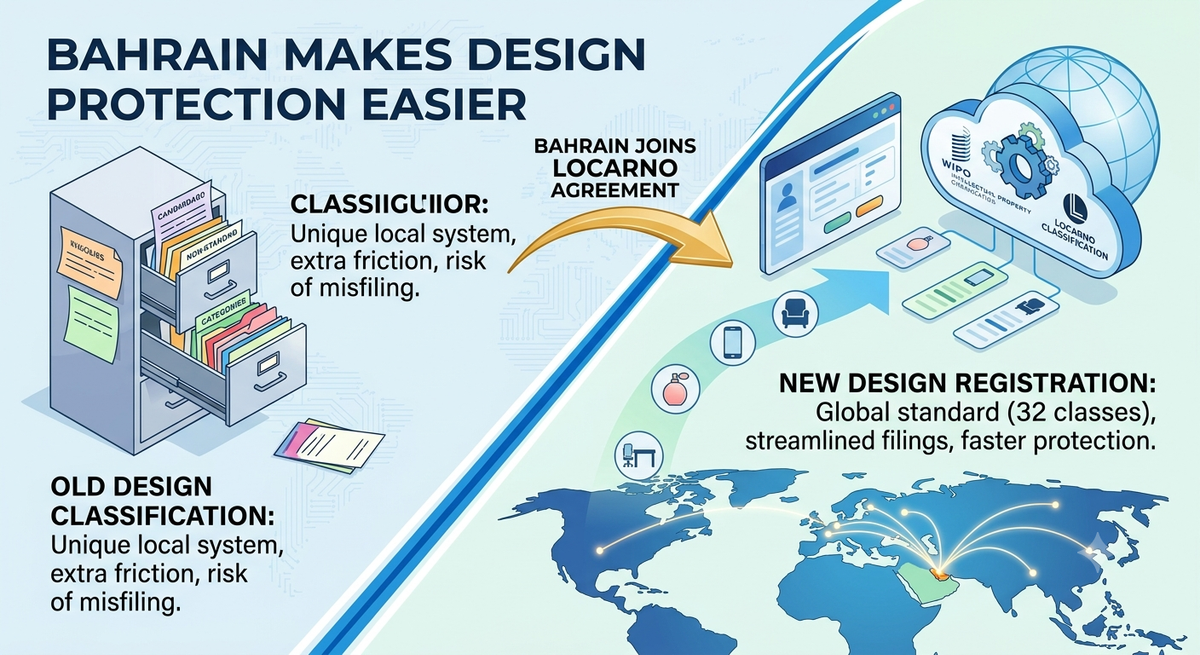
If you've ever tried filing a design registration in a country with its own quirky classification system, you know the headache: different codes, different categories, different chances of your filing getting bounced back over a technicality. Bahrain just took that headache off the table.
The Kingdom has officially joined the Locarno Agreement, the World Intellectual Property Organization (WIPO) treaty that gives the world a shared language for classifying industrial designs — think product shapes, packaging, furniture, smartphone interfaces, anything with a distinctive look worth protecting. The move came into force through Law No. 21 of 2026, and it marks a quiet but meaningful upgrade to how Bahrain's IP system talks to the rest of the world.
What Actually Changed
Before this law, anyone wanting to protect the visual design of a product in Bahrain — say, the silhouette of a perfume bottle or the housing of a consumer gadget — had to work through a homegrown classification system built specifically for the local market. It worked, but it meant extra translation, extra risk of misfiling, and extra friction for foreign applicants who weren't familiar with Bahrain's categories.
Now, Bahrain's Ministry of Industry and Commerce (MOIC) has folded its entire design-registration process into WIPO's Locarno Classification — the same 32 main classes and 200-plus subclasses used by dozens of IP offices around the globe, from the EU to the US to much of Asia.
Why It's a Bigger Deal Than It Sounds
One classification system, everywhere. Filers no longer need to relearn a new set of codes just to protect a design in Bahrain. The same numbers that work in a European or US filing now work there too.
Global databases finally line up. Bahraini design filings will now surface alongside international registrations in tools like WIPO's Global Design Database, making prior-art searches and competitive monitoring far more reliable.
Fewer rejected applications. Mismatched classifications are a classic reason filings get kicked back for correction. Aligning with the international standard should mean smoother, faster processing for companies filing multi-jurisdiction design portfolios.
The Bigger Picture
This isn't a flashy headline, but it's exactly the kind of behind-the-scenes harmonization that makes life easier for IP practitioners and rights holders working across borders. Every country that adopts the Locarno standard shrinks the "translation layer" between national IP offices — and for companies building global design portfolios, that adds up to real time and cost savings.
Bahrain joins a growing list of jurisdictions syncing up with WIPO's classification frameworks, a trend worth watching as more Gulf states modernize their IP infrastructure to attract international filers and investment.
Source: The Global IP Magazine – Kingdom of Bahrain Joins Locarno Agreement
Comments ()